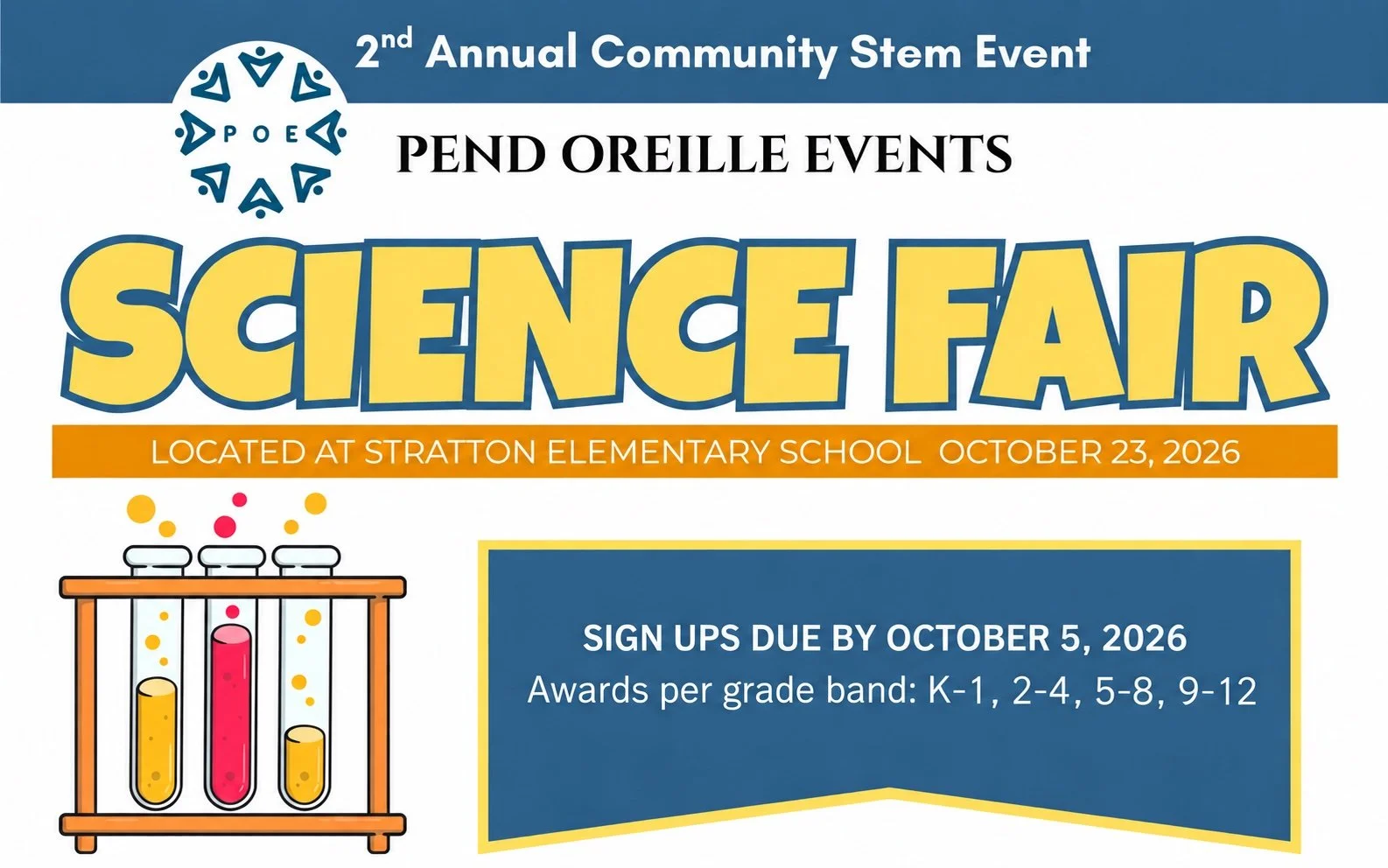
Student Science Fair
Brought to you by Pend Oreille Events
NEW THIS YEAR: There will not be formal presentations. Judges will be judging the project boards.
Event Location: Stratton Elementary School, Newport, WA
Eligibility: Open to all Pre-K through 12th grade students in Pend Oreille County and surrounding areas (including homeschool)
Project Drop-Off: Thursday, October 22rd, 2026 — Between 3:15 PM and 4:30 PM
Project Pick-Up: FRIDAY, October 23rd, 2026 — AFTER 6:00PM OR MONDAY OCTOBER 26TH ANYTIME DURING SCHOOL HOURS.
Public Viewing Hours: October 23rd, 2026 from 3:00 PM to 6:00 PM
Labeling: Please clearly label project with the student’s name & grade
Ready to Display: Frames, stands, or hangers are welcome if needed for presentation (These are not provided by Pend Oreille Events)
Safety: No hazardous materials, not contained liquids, or knives/weapon components. All projects are to be school and age appropriate. Students must get approval from P.O.E for the project(s) that they enter.
Fragile Work: We will handle with care, but POE cannot insure or guarantee against damage. POE and NSD do not assume responsibility for any items left behind or damaged.
Photography: Photos of the display may be taken for community sharing.
Parent Support: Younger students may have a parent or teacher assist with submission. This is a home-led project.
AWARDS: 1 GRAND PRIZE WINNER FOR CASH, CASH PRIZES FOR CATEGORIES: BEST SCIENTIFIC METHOD, MOST CREATIVE, FUTURE INNOVATOR & REAL WORLD IMPACT. RIBBON PRIZES FOR THE WINNER OF EACH GRADE BAND. OVERALL WINNER CANNOT WIN OTHER PRIZES.
*Want to volunteer for this, or future events? Please fill out our volunteer form: https://www.pendoreilleevents.com/volunteer

JUDGING CRITERIA
🧪 Science Fair Judging Criteria (Grades K–12)
⭐ Overall Scoring
Total Points: 100
Judges score each category and provide brief comments
🔬 1. Scientific Thought & Understanding (20 points)
What is being judged:
Clear understanding of the topic
Appropriate use of scientific concepts
Depth of knowledge (age-appropriate)
Grade-Level Expectations DISPLAYED ON PROJECT BOARD:
K–2: Basic understanding, simple explanations
3–5: Demonstrates learning and can explain “why”
6–8: Applies scientific reasoning and connections
9–12: Shows in-depth knowledge and critical thinking
🧠 2. Question, Hypothesis & Purpose (15 points)
What is being judged:
Clear question or problem
Logical hypothesis (if applicable)
Purpose of the project is well explained
Grade-Level Expectations:
K–2: Simple question or goal
3–5: Basic hypothesis or prediction
6–12: Testable, well-structured hypothesis
⚗️ 3. Experimental Design & Method (15 points)
What is being judged:
Planning and organization
Fair testing (controls, variables where appropriate)
Clear step-by-step process
Grade-Level Expectations:
K–2: Simple steps, teacher/parent-guided
3–5: Logical steps, some independence
6–12: Controlled experiment with variables identified
📊 4. Data Collection & Analysis (15 points)
What is being judged:
Data recorded clearly (charts, graphs, logs)
Accuracy and consistency
Ability to interpret results
Grade-Level Expectations:
K–2: Drawings, simple observations
3–5: Basic charts or tables
6–12: Detailed data, graphs, and analysis
🧾 5. Conclusion & Results (20 points)
What is being judged:
Conclusion relates to hypothesis
Explanation of results
Reflection on what was learned
Grade-Level Expectations:
K–2: States what happened
3–5: Explains results in simple terms
6–12: Connects results to scientific reasoning, discusses errors
🎨 6. Display (15 points)
What is being judged:
Neatness and organization
Visual appeal
Clarity of information
All Grades:
Easy to read, well-organized, creative but not distracting
🌟 Bonus (Optional – up to 5 points)
Creativity & originality
Real-world application
Effort and independence